Free Download Augustus (New York Review Books Classics)
Checking out books will certainly not obligate you to complete it in a day. After your reading book currently, Augustus (New York Review Books Classics) can be the selected book to be. We suggests due to the top quality of this publication. It features something new and various. You might not have to assume considerably, but simply check out as well as you will certainly see why this book is much advised.
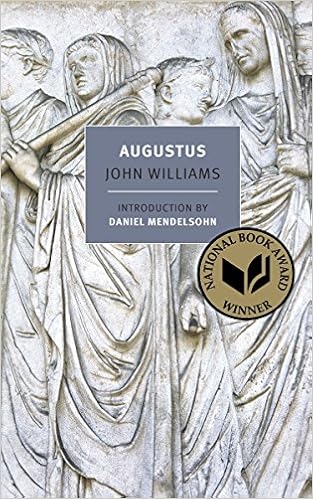
Augustus (New York Review Books Classics)

Free Download Augustus (New York Review Books Classics)
In accommodating the new updated publication released, we come to you. We are the on-line web site that always provides a really excellent method, fantastic term, and excellent listings of the collections books from many nations. Reserve as a manner to spread the news as well as information concerning the life, social, scientific researches, religious beliefs, several others holds a very important regulation. Publication might not as the style when they are out of day, they will operate as nothing.
The Augustus (New York Review Books Classics) that we provide for you will certainly be ultimate to offer choice. This reading publication is your chosen publication to accompany you when in your free time, in your lonesome. This sort of publication can aid you to recover the lonely and also get or add the motivations to be extra inoperative. Yeah, book as the widow of the globe can be really inspiring good manners. As right here, this publication is also developed by an inspiring writer that can make influences of you to do more.
In reviewing Augustus (New York Review Books Classics), currently you may not also do traditionally. In this contemporary age, gadget and computer will certainly assist you so much. This is the moment for you to open up the gizmo and also remain in this website. It is the appropriate doing. You can see the link to download this Augustus (New York Review Books Classics) right here, can not you? Simply click the link and also make a deal to download it. You could reach buy guide Augustus (New York Review Books Classics) by on the internet as well as prepared to download and install. It is extremely different with the traditional method by gong to guide establishment around your city.
Currently, reading this amazing Augustus (New York Review Books Classics) will be simpler unless you obtain download and install the soft documents below. Just right here! By clicking the connect to download and install Augustus (New York Review Books Classics), you could begin to get the book for your very own. Be the first proprietor of this soft documents book Augustus (New York Review Books Classics) Make difference for the others and get the initial to advance for Augustus (New York Review Books Classics) Here and now!
Review
“The finest historical novel ever written by an American.” —The Washington Post “[In Augustus] John Williams re-creates the Roman Empire from the death of Julius Caesar to the last days of Augustus, the machinations of the court, the Senate, and the people, from the sickly boy to the sickly man who almost dies during expeditions to what would seem to be the ruthless ruler. He uses an epistolary format, and in the end all these voices, like a collage, meld together around the main character . . . Read it in conjunction with Robert Graves’s more flamboyant I, Claudius and Marguerite Yourcenar’s Memoirs of Hadrian.” —Harold Augenbraum, Executive Director of the National Book Foundation “A novel of extraordinary range, yet of extraordinary minuteness, that manages never to sacrifice one quality for the other.” —Financial Times “Williams has fashioned an always engaging, psychologically convincing work of fiction—a consistent and well-realized portrait.” —Thomas Lask, The New York Times"Readers of both Stoner and Butcher’s Crossing will here encounter an altogether new version of the John Williams they’ve come to know: Augustus is an epistolary novel set in classical Rome. It’s a rare genius who can reinvent himself in his final work and earn high praise for doing so." —The Millions"Augustus is gripping, brimming with life." —Dan Piepenbring, The Paris Review Daily “This novel of an aged emperor will be intensely illuminating to anyone who is ready to put modern morality aside for a moment in order to acquire a little knowledge of himself or herself … The genius of this astonishing American writer is that he shows how lives that seem utterly strange can be very like our own.” —John Gray, New Statesman
Read more
About the Author
John Williams (1922–1994) was born and raised in northeast Texas. Despite a talent for writing and acting, Williams flunked out of a local junior college after his first year. He reluctantly joined the war effort, enlisting in the Army Air Corps, and managed to write a draft of his first novel while there. Once home, Williams found a small publisher for the novel and enrolled at the University of Denver, where he was eventually to receive both his B.A. and M.A., and where he was to return as an instructor in 1954. He remained on the staff of the creative writing program at the University of Denver until his retirement in 1985. During these years, he was an active guest lecturer and writer, editing an anthology of English Renaissance poetry and publishing two volumes of his own poems, as well as three novels, Butcher’s Crossing, Stoner, and the National Book Award–winning Augustus (all published as NYRB Classics). Daniel Mendelsohn was born in 1960 and studied classics at the University of Virginia and at Princeton, where he received his doctorate. His essays and reviews appear regularly in The New York Review of Books, The New Yorker, and The New York Times Book Review. His books include The Lost: A Search for Six of Six Million; a memoir, The Elusive Embrace; and the collection Waiting for the Barbarians: Essays from the Classics to Pop Culture, published by New York Review Books. He teaches at Bard College.
Read more
Product details
Series: New York Review Books Classics
Paperback: 336 pages
Publisher: NYRB Classics; Reissue edition (August 19, 2014)
Language: English
ISBN-10: 9781590178218
ISBN-13: 978-1590178218
ASIN: 1590178211
Product Dimensions:
5.2 x 0.7 x 8 inches
Shipping Weight: 11.2 ounces (View shipping rates and policies)
Average Customer Review:
4.5 out of 5 stars
215 customer reviews
Amazon Best Sellers Rank:
#13,054 in Books (See Top 100 in Books)
The American writer John Williams (1922 -- 1994) wrote only three novels in his adult life, but each is a masterpiece. His first novel "Butcher's Crossing" is a Western with elements of both "Moby-Dick" and Emerson. His second novel, "Stoner", set in academia, was a failure when published but received belated recognition to become Williams' best-known work. Williams received the 1973 National Book Award for his final novel, "Augustus", a historical novel set in the early days of the Roman Empire. I read "Augustus" after reading the earlier two novels. The setting in antiquity may make the book seem forbidding, but it is well worth the effort. The book is dense but splendid. The historical background for the novel will be generally familiar to those who have read Shakespeare's "Julius Caesar" and "Antony and Cleopatra."The novel is told through letters as well as memorandums, journal entries, and other writings of the protagonists, most of whom are historical figures. The epistolatory form allows the characters to speak in their own voices and to offer multiple points of views of the characters and events in the story. The entries in the book are not entirely chronological but frequently shift in time to illuminate events. The book follows the personal and political life of Octavius (63 B.C. -- 14 AD) from his youth to the end of his life. Octavius was the nephew of Julius Caesar who adopted him as a son. With Caesar's assassination, Octavius as a lad of 19 came to Rome and gradually prevailed after long struggles for power to become the first Emperor of Rome, receiving the honorific title of Augustus. I refer to the protagonist as "Octavius" rather than "Augustus" in this review. Williams offers a complex portrayal of a complex individual and era which includes many fascinating individuals in addition to Octavius.The work is in three parts. The first part follows the rise of Octavius and centers upon public life -- the rise of the young man when he comes to Rome with a few friends and allies. Octavius gradually rises to power and ends the ruinous civil wars plaguing Rome. The other major figure in the first part of the book is Mark Antony who sometimes works with Octavius but more often is his enemy. The book takes the reader through many battles including the Battle of Phillipi in which Antony and Octavius vanquished Brutus and Cassius, both of whom who had left Rome following their participation in the assassination of Julius Caesar, and the Battle of Actium, a sea battle in which the forces of Octavius destroyed Antony who was fighting on behalf of the treacherous Egyptian queen, Cleopatra. Rome faced many other military threats, including a threat from a pirate, Pompeiuus. The first part of the novel includes much fighting, and poltitical intrigue and character development in showing Octavius' rise to the position of Emperor.The second part of the book is set in the "Pax Romana" -- the lengthy period of Octavius' reign in which Rome faced no significant internal civil war or external threat. On the whole, this part of the book is more internally focused than the first part; but events of state are interwoven throughout with Octavius' personal life. A substantial part of the story examines the role of women, both in their relationship to Octavius, in their relationship to other men, and for themselves. Octavius' beloved daughter Julia assumes a prominent role through her (fictitious) journal. Octavius' skills as a ruler are shown, as is his love of poetry and learning. An important theme of the book is the relationship between personal and professional identities and roles, both of which tend to get lost and confused in the course of Octavius' life and, broadly, in the lives of most individuals in whatever culture and era they live.In the brief third part of the book, Octavius speaks in his own voice for the first time in the novel in the form of a long letter to a friend written near death. This part is the fitting capstone of the novel as Octavius (through Williams' imaginative voice) reminisces about how he sees his earlier life, its accomplishments and failures. This portion of the book is beautifully written (even by the high standards of the rest of the novel) with philosophical reflections on youth, middle age, and old age, discussions of power, wars, betrayals, sexuality, and love, the life of the mind, and religion. Williams creates a thoughtful, reflective individual with much to say about life, in Roman times and in our own.I loved this book, together with the two other Williams novels each of which is highly different in themes and writing styles. Williams avoids in "Augustus" the temptation to draw easy parallels to the events of his day allowing instead his characters and his era to speak for themselves. The result is a slow, compelling reflection on the complexities of a historical person, on a historical era, and on the human condition.Robin Friedman
Augustus by John Williams was my favorite book read of 2015. John Williams is a relatively obscure author who produced only five novels, most of which he penned while serving as a literary professor at the University of Denver. What he lacked in volume, he made up for in quality in this powerful novel alone, which was published in 1971.Augustus imagines the rise, reign, and ultimately the death (both physically and politically) of the Emperor Augustus. The novel is purely historical fiction, with much of the writings in the epistolary format in the form of letters and journal entries between and by the main characters. While the pace of the events is consistently marked by actual events that are known to us by virtue of being handed down by Roman historians, the dialogue that tracks the meteoric rise of Augustus to the Roman throne shortly after the assassination of Julius Caesar are masterfully created works of fiction and provides an imagined sense of the types of political rivalries, the machinations that occurred, the friendships betrayed, and lovers won and lost in such a world in which power becomes the sole pursuit of one's life and the reason for one's existence. The reader is treated to a panoply of famed historical figures throughout, including: Marcus Agrippa, the poet Ovid, the future Emperor Tiberius, King Herod, Cleopatra, Marcus Antonius (more commonly called Mark Antony), and many more.Fascinatingly, it is not these well-known figures that deliver the best narratives, rather the book's most poignant moments arise from the journal writings of the exiled Julia, Augustus's beloved and highly intelligent but ultimately tragically flawed daughter. Julia is exiled to the island of Pandateria upon the order of her own father, who has his hand forced politically by an adultery law that he implemented in a vain attempt at changing the morality of Rome. Due to other political maneuvers by Julia's husband, Tiberius, Augustus's unfortunate alternative was to allow Julia to be subjected to a public trial of treason, so exile seemed to him to be the lesser of two evils. I won't provide any more details than that so as not to spoil the enjoyment of anyone that picks up the book, but the despairing diary entries that Julia enters from her lonely island of exile provides a melancholic sense of a life wasted and perhaps a life that was born in the wrong time, as powerful and intelligent women could only advance themselves through hidden alliances and marriages to the men around them. Indeed, some of the most profound philosophical musings come from Julia's diaries on this topic. Of her both stepmother and mother-in-law, Livia (the mother of Tiberius, a husband Julia detested), Julia observes, "Of all the women I have ever known, I have admired Livia the most. I was never fond of her, nor she of me; yet she behaved toward me always with honesty and civility; we got along well, despite the fact that my mere existence thwarted her ambitions, and despite the fact that she made no secret of her impersonal animosity towards me. Livia knew herself thoroughly, and had no illusions about her own nature; she was beautiful, and used her beauty without vanity; she was cold, and thus could feign warmth with utter success; she was ambitious, and employed her considerable intelligence exclusively to further her ambition's end. Had she been a man, I do not doubt that she would have been more ruthless than my father, and would have been troubled by fewer compunctions. Within her nature she was an altogether an admirable woman."This challenge of craving power in subtle and hidden ways is something that Julia would turn to later, only remarking on her own inner pangs on the subject: "In this island prison, my life over, I wonder without caring at things I might not have wondered at, had that life not come to an end...It is odd to wait in a powerless world, where nothing matters. In the world from which I came, all was power; and everything mattered. One even loved for power; and the end of love became not its own joy, but the myriad joys of power...I have often wondered how I might have managed the power I had, had I not been a woman. It was the custom for even the most powerful of women, such as Livia, to efface themselves and to assume a docility that in many instances went against their natures."Aside from Julia's powerful writings, the most compelling dialogue happens at the twilight of Augustus's own life at the end of the book, when the reader finally gets to view Augustus's life from the contemplative and often regretful musings of a dying emperor who seems to be asking the painful question through his letters to Nicolaus of Damascus of whether his life devoted to ambition and power was actually worth the high cost of losing most of his friends and loved ones in the end. Interestingly, much of what we learn from Augustus in the preceding pages is indirectly from the writings of others, or when he does speak, it is in the form of commands or is in the form of active plotting for gaining power or keeping it. The writings at the closing of the book are the reader's first glimpse into the emperor's soul. Williams sets up the contemplations beautifully, as Augustus writes out to Nicolaus what he wants inscribed as a historical self-serving paean to himself to be posted on tablets at the Senate Forum, but then Augustus turns to how much folly is in those inscriptions and how much reality they fail to capture; how much ugliness of power that he can't possibly divulge. He writes these introspections to seemingly the one man he can trust with them. One of my favorite paragraphs will give the reader of this review a small taste of the ability of Williams to bring a character to life and to infuse philosophy into the narrative attributed to the imagined words of Augustus:"Mankind in the aggregate I have found to be brutish, ignorant and unkind, whether those qualities were covered by the coarse tunic of the peasant of the white and purple toga of a senator. And yet in the weakest of men, in moments when they are alone and themselves, I have found veins of strength like gold in decaying rock; in the cruelest of men, flashes of tenderness and compassion; and in the vainest of men, moments of simplicity and grace.â€I have put my focus on the writings of Julia and Augustus, and in so doing perhaps I have neglected the significant components of the book that are devoted to Augustus's ascent to power and his lifelong struggle to maintain that control. Indeed, this is perhaps part of the book that moves the quickest, as there are plenty of moving scenes and lines delivered within the subtext of dark plots, friends betrayed, friends that betray Augustus, political marriages devoid of true love, significant battles, and the paradoxical weaknesses and strengths of man on full display throughout.
Augustus (New York Review Books Classics) PDF
Augustus (New York Review Books Classics) EPub
Augustus (New York Review Books Classics) Doc
Augustus (New York Review Books Classics) iBooks
Augustus (New York Review Books Classics) rtf
Augustus (New York Review Books Classics) Mobipocket
Augustus (New York Review Books Classics) Kindle
0 komentar:
Posting Komentar